Renewed interest in the
LPWS in 2011 has brought to light the story of
the evolution of the GB3MH Laughing Boxes.
We have just been
contacted by a long serving LPWS member who gave
us 2 of the remaining boxes he built, and told
us the history, many thanks!
Below is a
mildly re-written version of the write-up he
sent me, all I have done is correct spelling and
grammar, no changes have been made to the
details.
With all the other
repeaters in the Midlands area well served with
jammers etc, GB3MH remained fairly quiet, so in
the late 1980's it was decided to give this
languishing repeater a bit of a going .with many
other services including some operated by RRE
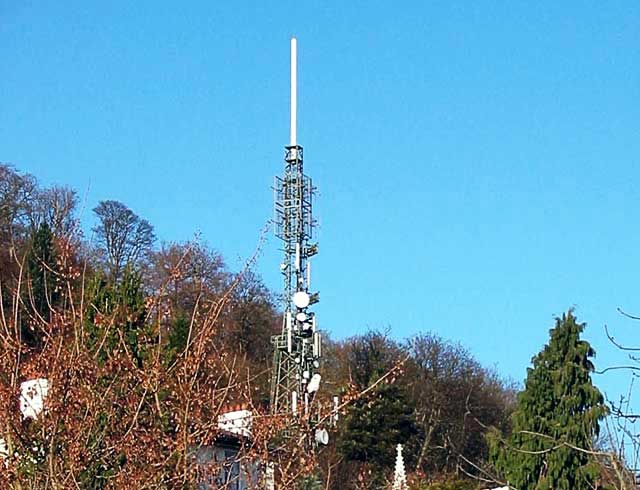
Malvern. The hills are the highest point for
miles around, and the tower's red light could
easily be seen from over 50 miles away.
Operated by a bunch of
loonies from Worcester, the repeater group were
particularly badly served by GB3MH due to
Worcester being at low altitude, when
surrounding areas much further away, had a line
of sight view of the tower and a much lower
powered signal could blot out much more powerful
stations in the Worcester area. The mast was not
actually on top of the hill so coverage was very
directional over Worcestershire. When driving
just over the hill, the GB3MH signal would fade
away and at about 1 mile down the other side of
the hill, it could be barely heard.
First automatic
prototypes were very crude by today's standards,
but experience taught us that simple was better.
We actually lost the first prototype, it was
stolen by a group of amateurs from Worcester,
but it was hardly hidden, just on test. A
valuable lesson was learnt, so possibly money
well spent, as we never lost another device
after that one.
One of our very early
boxes was accidentally remarkably successful.
It did nothing much really, however the anger at
what this simple device did, exceeded anyone's
wildest dreams!
Nicknamed by the local
hams "Tony Tone-Burst", it was
originally deployed just to test the timer and
tone-burst, and to see if it worked well out in
the field, and if it would access GB3MH without the benefit of a proper
antenna.
All it did was
periodically transmit a 500 millisecond access
tone-burst, but due to a complete fluke in the
setting of the timing interval, it would resend
the access tone-burst as the repeater was
closing down and was sending the Morse ID. This
meant that GB3MH was kept active with just a
very short ½ second transmission burst, for
reasons we can't imagine, no one would attempt
to use the repeater when this device was
operating.
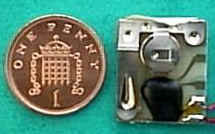
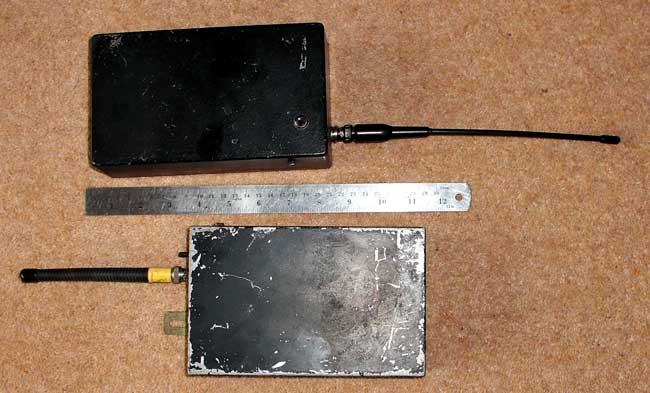
There were
at least 3 of these in smallish die cast alloy
boxes, running on NiCads, one had a small coiled
antenna plugged into a BNC connector, and 2 with
¼ wave wire and a
crocodile clip.
The first one could be deployed anywhere, the
antenna could be removed and the unit plugged into a car
or at someone's home.
The ones
with crocodile clips would either run alone or attached to fencing or barbed wire somewhere in the countryside
where the Malvern Hills could be seen,
experimentation had shown that this worked well,
even in the rain and some 30 miles away from the
repeater. We assume that it transmitted
using a kind of "long wire" antenna. It did work
remarkably well, but we don't exactly know why.
On the plus side, the signal seemed to be coming
from quite a large area and no definite single
position.
A good feature of this simple device was that the
batteries lasted almost a week, we tried leaving
one hidden in Auction Rooms in Malvern, it ran
24 hours a day for over 6 days, and was recovered from
its hiding place, on top of a cabinet, some 2
weeks later at the next auction.
Let's be
honest about this, most radio amateurs are not
"quick on the uptake", it was almost universally
believed that this wasn't automatic, the loonies
actually thought someone was sitting there
pressing the tone-burst every 40 seconds or so,
unbelievable!
A slight
variation of this device was a simple timer
circuit with a small relay built into a small
plastic box on the end of a lead with a mike
plug on the end. I saw this being used on an
ICOM, the 2 sets of contacts on the tiny relay
made a circuit between the pins for the PTT
switch and the radio's built in tone-burst, the real beauty of
this device was that 12 volts were available on
the mike socket, so all you had to do was plug
it in, no battery required. This was a novel
adaptation, and cost less than £15.00 to make.
The One They Couldn't Find!
After these tests had shown what was
possible, more elaborate devices were made. There were
NO digital recording devices at the time, so the only useable
audio source was an auto-reverse Walkman style AIWA
cassette player. This worked, but the total power
requirement was too great. After a meeting, and a "whip
round" it was decided to make a more elaborate version of
this device for a countryside location.
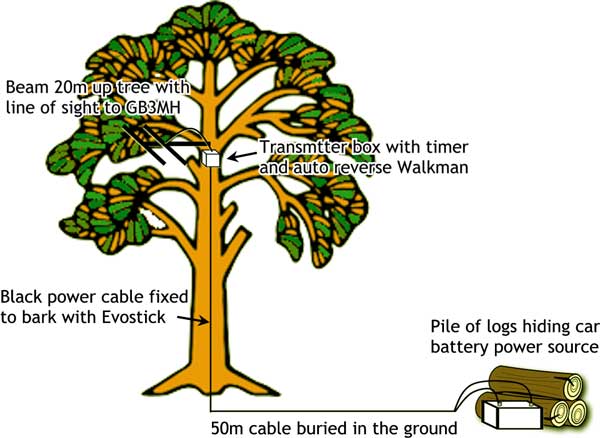
A Yagi 3
element beam was sprayed matt black, and with the help
of a 3 section ladder, it was fixed way up in a tree,
and pointed at the Malvern Mast. The box of electronics
consisted of 2 chiming quartz clock mechanisms set 30
minutes apart to trigger the 30 second timer. The
Tone-burst and transmitter boards were supplied by Wood
& Douglas, both quite good and robust. The tone-burst
automatically sounded when power was applied to the 1
Watt transmitter. Experimentation showed that hard
wiring the audio from the Walkman to the mike input
didn't work, it seemed to pick up too much local RF, so
a small mike was fixed in front of the speaker of the Walkman,
which was set to play auto-reverse with a tape of the
laugh from the Laughing Policeman Song.
The antenna was connected to the
transmitter and Walkman box which was also placed high
up in the tree. The clever part of this set up was that
a black cable was run down the tree trunk and attached with Evo-Stick, where it reached the ground, a shallow trench
was dug and the cable went underground to emerge inside
a pile of logs some distance away. Here, we were able to
hide a car battery to remotely power the tree-top
device.
All you had to do was clip
the battery on, and off it went, twice an hour,
automatically.
This was a quite expensive project, the transmitter
and tone-burst cost over £100 from Wood & Douglas, the same
figure again for the
Walkman, add to that a roll of black twin power
cable, plus about £25 for a
decent car battery and it was by far our most expensive
project.
It was highly successful
due to the line of sight to the repeater mast,
BUT it was D-Effed 100%, but the wankers spent
ages within a few feet of the device and they
still couldn't find it!
As usual, their search was monitored on 70Cms,
We imagine that they thought
we were unlikely to hear them on that band, this still
is quite a source of amusement today.
Sadly, as the location
was discovered we decided to leave the complete
device in situ for quite some time before
recovering the battery and getting back up the
tree for the box of electronics. The beam stayed
in the tree for many years and we went to
photograph the location and show you the aerial
still up the tree and the cable hidden in the
bark but when we got there, the tree, along with
a few others, had been felled.
Important Lesson
An important lesson was learnt here, you can't use a
fixed location as someone will eventually find the
device and steal it, so we embarked on designing a
different type of device.
The main problems we came across with the prototypes
were ingress of water and power supplies that would last
a reasonable time. There was no way we could find a useable remote
mains power source,
so we had to use battery power. At the time there were
NO NiMh cells and no one had even thought of lithium ion,
so lead acid jelly batteries from burglar alarms were
used, luckily one of our members worked in this field
and we were able to use nice compact 1.2Ah battery.
When we were making these, someone had a
greeting card sent to them that had a small circuit and
battery inside that laughed when you opened the card,
brilliant, no need for the Walkman any more, £100 per
unit saved. The audio output from the laughing chips
worked straight into the mike connector. These cards cost
around £5.00 each, they came
with 1.5v button cells but these were replaced with Duracel AA cells, we never had to replace one.
Deployment
To confuse the opposition,
which was 100% successful, we deployed 3 identical
devices. Chiming quartz clock mechanisms were found
to be very cheap timers, exactly the same as an
ordinary clock movement but with 2 wires that
momentarily completed a circuit once an hour. We set
these 20 minutes apart so the 20-30 seconds of "the
laugh" went off 3 times per hour, 24 hours per day.
We found that this was more than enough to send the
hard core loonies right round the twist!
Each box was in vastly
different areas, but all with line of sight to the
repeater mast, and each box had at least 2
locations. Each box was looked after by different
people. It was their job to deploy the device,
monitor the repeater for their box, which would be
on the hour, 20 minutes past, and 20 minutes to.
When the battery gave out, collect the box,
recharge, and re-deploy in the alternate location.
It sounds like a lot of effort, but it was really no
trouble at all.
Experience dictated that
this was the best way to achieve the most, with the
minimum of effort, and with virtually no chance of
anyone ever finding a transmitter box, unless it was
by complete chance.
It was interesting listening
to the DF crews on 70Cms, who had no idea what they
were looking for, and no idea where they were they
were hidden. It was a widely held belief that
someone was driving about the area, that was their
only conclusion when, after waiting another 20
minutes with the signal coming from a completely
different direction.
As you can see from the pictures, they are dead
crude, but they worked and they worked well, which is
all that matters. As you can see, the main transmitter
is secured by the power transistor heat sink, the
tone-burst is also bolted to the casing. The laughing
module is powered by an AA cell, and the 555 timer
circuit is triggered by the pulse from chiming clock
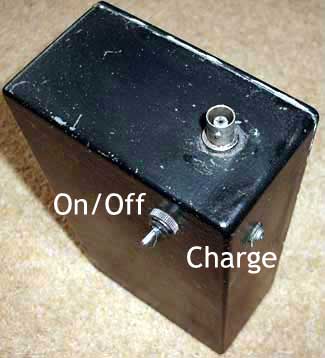
mechanisms. A waterproof power switch and an insulated
tag for recharging complete the design, which was sealed
into a die cast project box with silicone.
A slight problem we found with this design, was that
the battery would give off a gas when recharging, that
corroded the printed circuit of the transmitter board. The
final version was much smaller with the battery outside the alloy case, this
cured all the problems, but we were aware this could
cause alarm if any of the units were found as it looked
like a cartoon depiction of a time bomb. Luckily, LPWS
newer had this problem, unlike the well reported
copy-cat devices made in the Aylesbury area.
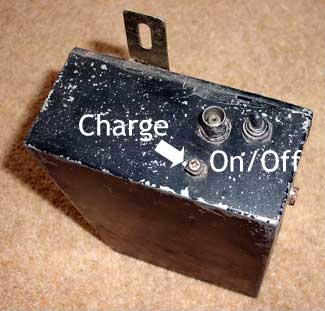
*NOTE I asked
why only one had a mounting bracket fitted,
it seems that the other one used to have a
hook made from a coat hanger. It was formed
into a loop at one end and slid over the BNC
connector before attaching the antenna, the
other end formed a hook which was used to
hang it in a tree or in a hedge. The idea
was to attempt to use whatever it was hooked
to as a ground plane. A fair idea, but I
doubt if it made the slightest difference.
The 2
Remaining Boxes
We are grateful
for the supply of the 2 remaining boxes,
which we are now going to open and share
the pictures with you.
These are crude
devices, but trial and error dictated
this design, and the fact that they were
never located and never failed in use
bears this out. These 2 boxes were made by the same
person a few weeks apart and have
remained sealed since the very early
1990's.
When we finally
got one of the boxes open, the first
time in 20 years, we were surprised to
find it in remarkably good order. The
digital recording module had lost its
audio as the 6v battery pack was flat. All 3 quartz clock movements were silent
as the batteries were flat. (we were
expecting only one timer in this box).
However, upon applying 12 volts to the
transmitter, IT STILL WORKED!
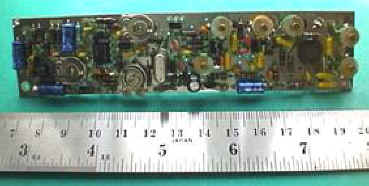
This
design used the popular Wood &
Douglas transmitter board, this was
found to be by far the best of all
the designs available at the time.
It was robust, transmitted a fine
signal accurately on frequency, and
was very economical with its power
requirements, a very important
feature of a remotely deployed
device. The only downfall was the
price, almost £100 each.
Luckily, a
kind member donated 4 to us, 3 were
used in the field and 1 remains
unused. We were very successful with
our devices after having the first
prototype stolen, we heeded the
lesson, and no one ever came close
to finding any of our various
devices after the initial loss.
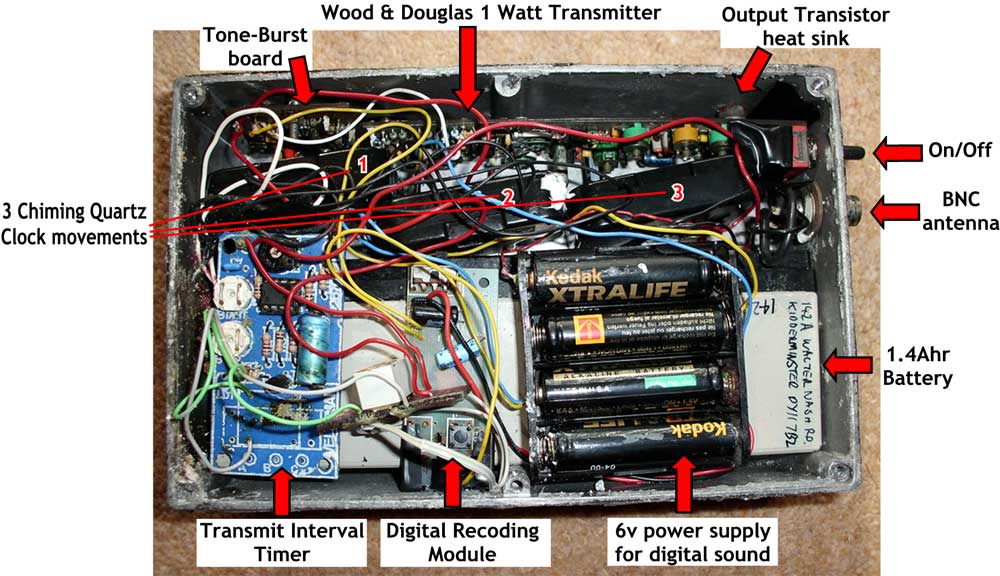
This is one of
the 2 remaining boxes, and with very minimal signs
of corrosion:-
I was previously
unaware of any box that went off 3 times
per hour, as this one obviously did, but
I expect that when up and running with 2
others, finding the direction of a 30
second
signal on the repeater input channel
would still be a virtual impossibility.
Dead simple, if
crude construction, in modular form. The
quartz clocks tripped the transmit
interval timer, this supplied power to
the transmitter and started the digital
recorder. The tone-burst automatically
sounded for 500mS when power was
applied. This set off a recording of the
laugh from Charles Penrose's Laughing
Policeman Song. Dead simple, dead
reliable, and dead annoying.
Many designs
were tried, but the close location of RF
interfered with a lot of the circuitry,
and although it looks a bit amateurish
to use commercially available hobby
kits, this design did work reliably, and
that is all that matters.
These devices
were placed in different locations, the
clocks were set to trigger the laugh at
varying intervals so the effect was that
of someone playing the Laughing
Policeman Song on the repeater 4 times
an hour, but in reality the 30 second
bursts of transmission were coming from
what must have appeared as random
locations!
These worked
very well for years and no one ever
found one, the resulting mayhem on the
repeater was often hilarious!
Great effort was
made to find them, but without any of
the "opposition" knowing what they were
looking for, they spent a long time
driving around and DFing the signals
with the conclusion that the signal
source had to be mobile. It was highly
entertaining to listen to them on 70Cms
trying their best, night after night, to
find where the signal was coming from.
Actually,
amongst the several locations were a
hedge, a barn, an apple orchard, and
hung in trees with a hook made from an
old coat hanger. Collection and recharging
was done on a rota basis by several LPWS
members, before they were re-deployed at
rotating locations.
Sadly GB3MH is
no longer active and the replacement
repeater, GB3NW, is not in such a
good position for this kind of fun.
Plans are in
hand for a CTCSS based device using one
of the cheap Boafeng radios as the
signal source.
Thanks to Lewis
Ringway in Manchester, for an
independently made documentary about our
Repeater Improvement devices.
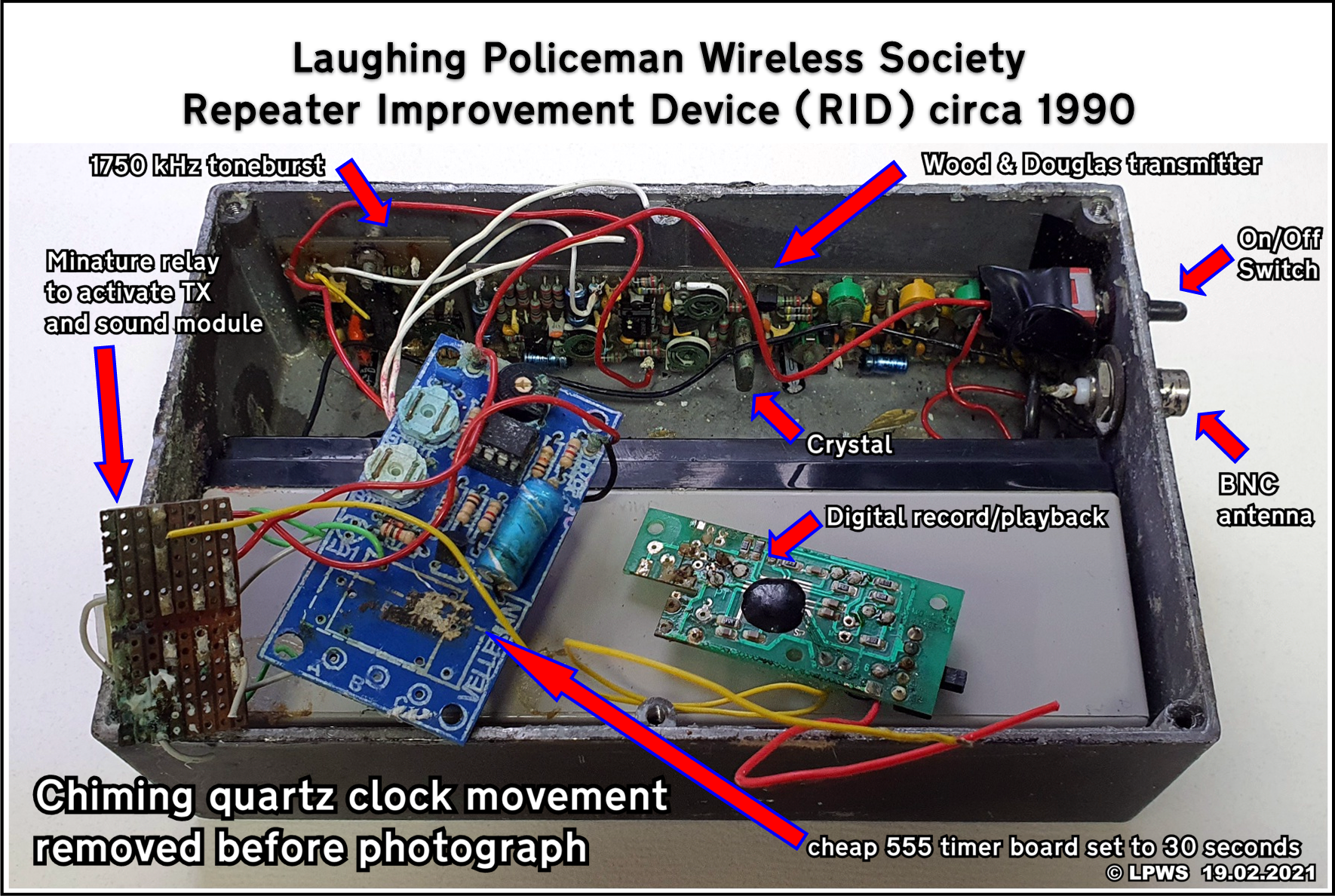
Since that hit YouTube, another Laughing
Box has come to light, basically similar
to the one shown above, this one was
opened for the first time this century
on 19th February 2021 to find it in fair
condition. The AA batteries has
decomposed, but everything else looks
OK. The unit was tested with 12 volts
and still transmits with the old style
repeater access tone.
Click above for larger image.
Crude by today's standards, but they
worked 100%, they were never found, and
were deployed by a team of volunteers
who would collect them about once a
week, recharge the unit by an insulated
pin with the body being -ve, and then
relocating them at several different
places around the W.Mids area, but with
line of sight to the GB3MH repeater.
These 1 Watt units would easily trample
all over most of the users in the
Worcester area as we always selected
high ground. GB3MH was uniquely placed
halfway up the side of the Malvern Hills
making the area of reception quite
directional.
The Laughing Policeman Wireless Society is a
non-profit organisation for the furtherance of amateur radio. With annual turnover of less then GBP £1000,
LPWS qualifies for UK Charitable Status.
Access to, and use of
this web site is subject to these Terms of use



 This
design used the popular Wood &
Douglas transmitter board, this was
found to be by far the best of all
the designs available at the time.
It was robust, transmitted a fine
signal accurately on frequency, and
was very economical with its power
requirements, a very important
feature of a remotely deployed
device. The only downfall was the
price, almost £100 each.
This
design used the popular Wood &
Douglas transmitter board, this was
found to be by far the best of all
the designs available at the time.
It was robust, transmitted a fine
signal accurately on frequency, and
was very economical with its power
requirements, a very important
feature of a remotely deployed
device. The only downfall was the
price, almost £100 each.